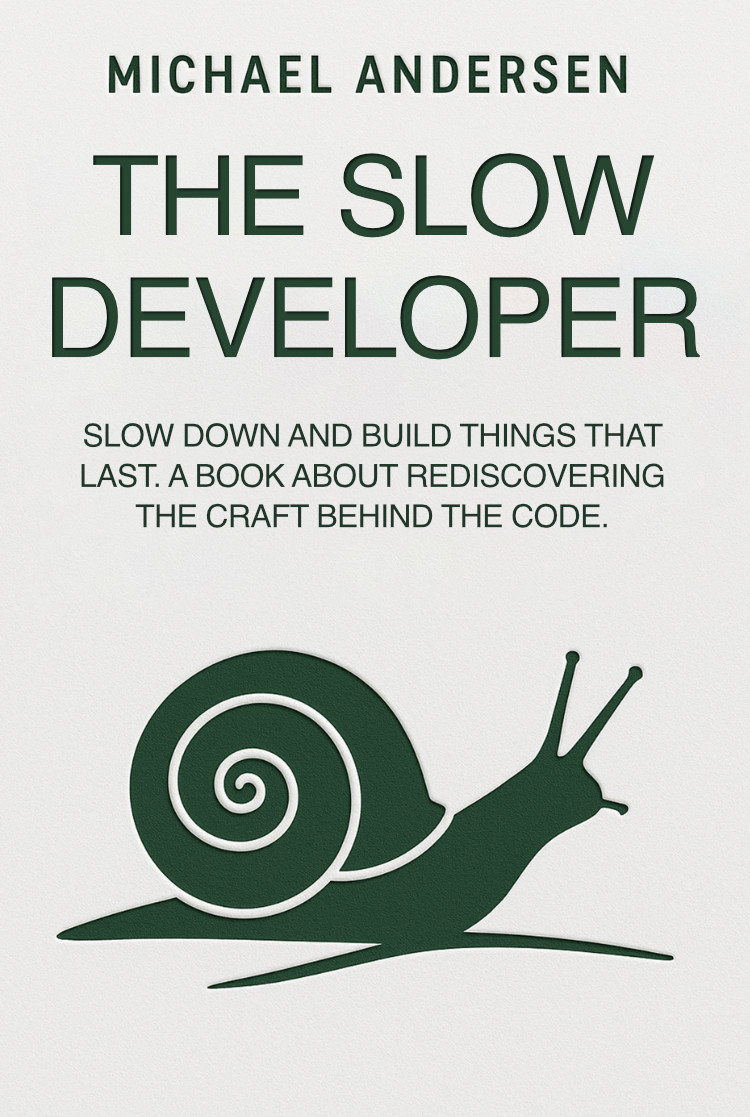
The Slow Developer
A practitioner's case for slowing down, thinking deeply, and building software that stands the test of time.
About the book
The software industry is obsessed with speed. Fast releases, sprint cycles, 10x developers, and 'move fast and break things'. The culture rewards the immediate and punishes the careful.
This book makes the opposite case.
Across twelve chapters, I explore what happens when we don't take time to think: technical debt that compounds, systems that become unmaintainable, and teams that slow themselves down with years of rushed decisions. And more importantly: what it looks like when you do things differently.
The Slow Developer is not about programming slowly. It is about designing with intention, writing code that communicates clearly, and building careers that last. The best developers I have worked with move with calm, because they know that speed is a product of clarity, not of hurry.
What's inside
-
01
An Industry on Speed
The phone lights up before the alarm rings. Slack, pull requests, emails from colleagues in other time zones. The day hasn't started, and you're already behind. This chapter looks at how constant notifications, context switching and an always-on culture have become the norm in tech, and what that does to the people working inside it.
-
02
Framework Fever
There is always something new. A framework that promises to make everything easier. A technology that is supposedly the future. This chapter explores the constant pressure to keep up, the difference between learning frameworks and understanding fundamentals, and why the tools we choose should serve the problem, not the other way around.
-
03
When Speed Kills the Craft
There is a difference between code that was written with care and code that was written in a hurry. This chapter looks at what craftsmanship means in software, why flow states matter, and what we lose when there is never enough time to do things properly.
-
04
Slowness as Strength
From the Slow Food movement in Italy to slow business and slow living, there is a growing recognition that speed is not always the answer. This chapter makes the case for slow development. Not as an excuse to do less, but as a way to achieve clarity, quality and better decisions through deliberate work.
-
05
Simplicity as a Design Principle
Dieter Rams said it: good design is as little design as possible. This chapter traces that idea from industrial design through to software, exploring why every feature has a hidden cost, why complexity grows almost by accident, and why principles like KISS and YAGNI exist for good reason. With examples from Google, Craigslist and Apple's early design choices.
-
06
Sustainability in Digital Craft
The internet accounts for more carbon emissions than the aviation industry. But sustainability is not only about the environment. This chapter connects the dots between environmental impact, mental health and the way we build software. The principles that reduce a product's carbon footprint are often the same principles that make it better to work with.
-
07
Architecture That Lasts
Some code lasts for years and adapts to new requirements without falling apart. Other code starts crumbling after a few months. This chapter covers modular design, building solid foundations, avoiding technical debt, and the kind of clarity in structure and naming that makes a codebase a pleasure to work with rather than a burden.
-
08
Code Less, Build More
The best code is often the code that was never written. Every line added is a line that must be maintained, tested and understood. This chapter explores the art of doing more with less: finding the smallest effective solution, reusing what already exists, and having the discipline to cut features that do not carry their weight.
-
09
Slow Pace, High Quality
Quality cannot be added after the fact. It has to be built in from the start. This chapter looks at the relationship between tempo and quality, the power of deep work, why pauses are not the opposite of productivity, and how to create realistic time estimates. It also honestly addresses what it feels like when slowness is uncomfortable.
-
10
Teams, Culture and Long-Term Quality
You can change your own way of working, but most of us are part of teams. This chapter looks at how leadership sets the tempo, how invisible cultural rules reward speed over quality, and what it takes to build a team culture that values focus, stability and craftsmanship. Including practical ideas for rituals, meeting discipline and quieter collaboration tools.
-
11
A Digital Life with Meaning
The tempo at work does not stay at work. It follows you home. This chapter explores how the pace of the industry affects our lives outside of it, what digital minimalism looks like in practice, and why making room for nature, offline time and genuine presence is not a luxury but a necessity for anyone who wants to sustain a long career.
-
12
The Future of Digital Craft
If we continue on the current path, we know roughly what comes next: more speed, more complexity, more burnout. But there is an alternative. This final chapter looks at where the industry is heading, the role of AI, what companies gain from slow development, and how we can educate the next generation of developers differently. It ends with an invitation to choose a different way.